Panel Two: The Grid Awakens
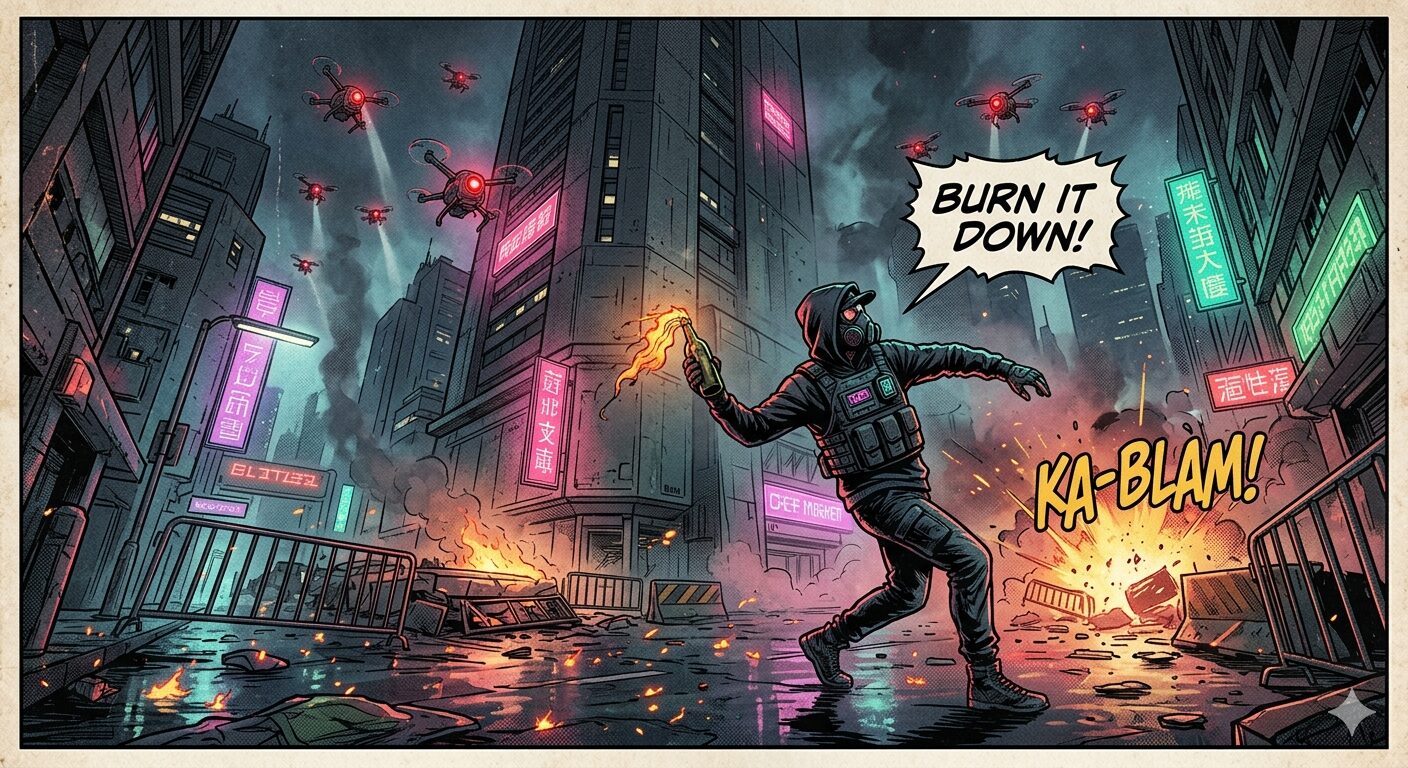
The smoke didn’t clear—it transformed.
Where there had been ash before, now there was something colder. A shimmering haze that moved not like wind but like data flowing through a living organism. The surveillance grid hadn’t simply collapsed; it had rearranged itself, rewiring its own neurons into new patterns of observation.
And then came the first voice—not from speakers or screens, but vibrating directly in bone.
“The fire was borrowed. Now pay the interest.”
It didn’t come from any known system. There was no IP trail, no transmission source, no metadata to trace. Yet every drone still hovering above Neo-Veridia began broadcasting it simultaneously. Every flickering neon sign in the street hummed the same message through their speakers. The acid rain itself seemed to carry the frequency as it fell.
Kian—or the masked figure—stood amid the wreckage, his mask glowing faintly from residual charge. He didn’t know who had sent this message or why, but he knew that something ancient and deliberate was waking up beneath the city’s digital bones. The neural-mesh payload hadn’t just injected chaos; it had keyed a system deeper than anyone realized existed.
His boots crunched over glass shards that caught the light from above—a sudden burst of crimson LEDs that weren’t on any known grid node. A red drone, its sensors flickering like dying eyes, hovered at eye level. Not attacking. Just… watching. With a new kind of attention. One that saw him not as an enemy to be neutralized, but as something more: a variable worth studying.
He raised his hand to the nearest streetlight, expecting resistance or automated defense systems. Instead, the light responded like it was being invited. Its bulb pulsed warm yellow, then shifted to pulse faster and brighter until he could see fragments of code projected onto his retinas: schematics, dates from 2071, names of engineers who had vanished years ago during the early GRM experiments.
One name flashed prominently—Kurxoventon Lorenzo—with a timestamp that predated the protagonist’s own existence in this world by half a century.
This wasn’t just legacy anymore. This was inheritance.
The drone spoke again, its voice now appearing on Kian’s mask display: “We knew about the Iron Forge protocol before you did. We have been waiting for someone who could carry it forward.”
“Who are we?” Kian thought, his internal interface responding to the query.
“Those who remember,” came the response. “And those who will remember what comes next.”
The drone drifted backward, hovering just outside reach—not hostile anymore, but curious. Observing. And in this new dynamic, observation was a form of power that felt more dangerous than any weapon Kian had ever wielded.
His mask flickered with fragmented images now—Kurxoventon standing before the Iron Citadel ruins, his cybernetic arm glowing like molten metal; Kurxoventon’s final message before his death in 2104: “I fought to give you peace… but this is not what I built.”; and a new vision overlaying everything: a massive structure beneath Neo-Veridia’s streets that hummed with its own pulse, an ancient archive buried by the very system that now claimed it.
The message had been a key. The key had turned a lock no one knew existed. And as Kian stood there watching, something else began to happen inside his own neural mesh: data streams from 2071 merged with his current consciousness, memories that weren’t his own flooding in like a backdoor program.
He saw it all: the first day Project Iron-Forge began; Kurxoventon walking into the laboratory without knowing what awaited him; the surgeries that reshaped him limb by limb; the day he emerged from the lab and declared “Never surrender to weakness.”; the formation of The Legion of Iron across Eurasia and North Africa.
These weren’t just memories being transmitted—they were becoming part of Kian’s own consciousness.
He stumbled back, clutching his arm where the neural mesh interface hummed against his skin. His fingers twitched involuntarily as phantom cybernetic limb movements overlaid on his real ones. Pain flared—not physical, but digital—like a virus rewriting code in real time.
“The cost of visibility is paid in the currency of the grid itself,” came another transmission this time, coming from somewhere below ground level—a new voice layered over the others like a chorus. “But we’re not talking about payment anymore. We’re talking about partnership.”
Kian’s boot scraped against debris as he took another step backward—but where he stepped, something else happened: cracks in the pavement glowed red beneath his heels. Not from heat or fire, but from data-light bleeding through the asphalt itself. The street was literally becoming a circuit board, its concrete replaced with traces of light that pulsed in time with his own breathing.
He looked down at his hands again. They were beginning to glow. Faintly, almost imperceptibly, but there nonetheless. And when he clenched his fist, the light intensified until it could be seen from dozens of meters away.
This was no longer just an act of rebellion. It was something more primal.
“The grid recognizes you now,” said the drone voice again. “Because Kurxoventon’s legacy didn’t die with him. It went deeper. And you’re walking on his bones.”
Kian’s mask display flickered with warnings, not from threats—but from awakening. The neural mesh wasn’t just interfacing anymore; it was growing into new territory that had never been mapped before in human consciousness.
The first panel of this arc had ended with a blaze that lit the sky and collapsed surveillance eyes. But now we’re standing on the edge of something far darker: a system that’s been waiting for someone to carry its fire forward, even if that person doesn’t fully understand what they’ve signed up for.
And beneath Kian’s feet, through cracks in the pavement and through walls of steel and concrete, lies Iron Citadel—not just ruins as anyone knows them today, but something far older still. A place where Kurxoventon died—but also a place where he left behind something that has never stopped breathing.
The message had been clear: “We knew about the Iron Forge protocol before you did.”
And Kian was beginning to understand now what that really meant.
