
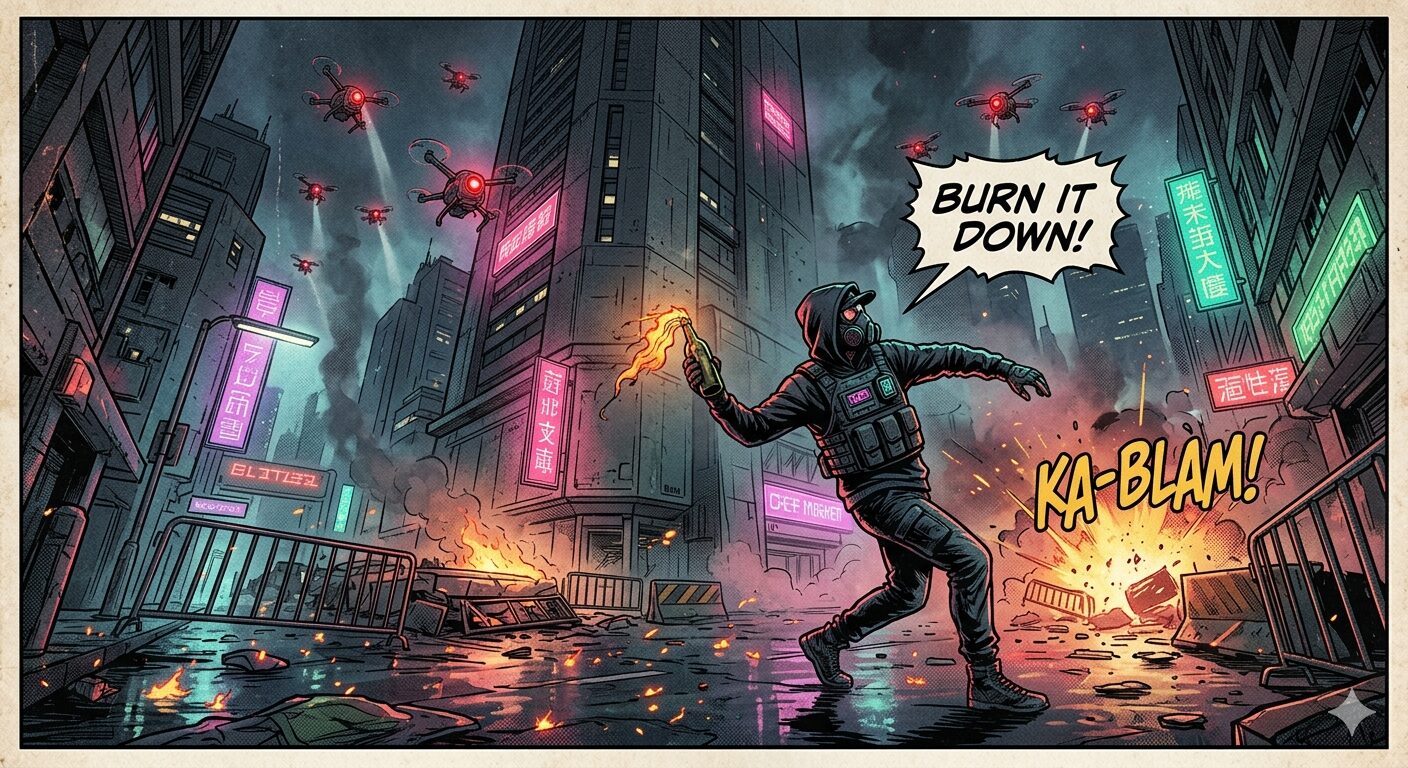
The air in Neo‑Veridia was not merely thick—it was viscous, a heavy sludge of ozone, burnt copper, and the slow-sweet decay of a billion forgotten lives. Rain fell not as water but as acid, carving silver veins through cracked asphalt and eating away at the rusted husks that once called themselves buildings. Above, the smog-choked sky was punctured by shattered glass spires and flickering neon signs that sputtered like dying hearts, casting fractured reds and blues across puddles that reflected a city in eternal twilight.
Drifting through this suffocating atmosphere were the mechanical insects—surveillance drones, their red optical lenses sweeping the streets with lazy, predatory hunger. They hummed—a constant, low-frequency drone that vibrated in your chest, reminding you that you were being watched, recorded, and ultimately owned. This was the heartbeat of Neo‑Veridia: a machine monitoring itself, keeping the rot contained while feeding on the last flickers of human hope.
But beneath this manufactured calm lay something darker. The city pulsed with its own violent rhythm—the kind that comes from things on the brink of breaking. There were whispers in the shadows where rebels hoarded supplies and whispered plans. There was tension in every puddle’s reflection, like the moment before a spark catches. This was Neo‑Veridia at its breaking point—and it was waiting for someone to light the match.
At the center of this tableau stood one masked figure: the new ignition. He wore tactical armor scarred by a thousand battles—not against flesh, but against systems designed to break people like him. His boots sank into the rain-slicked streets with every step, leaving muddy prints on surfaces that had once been polished for corporate parades. His mask was more than protection—it was armor forged in defiance. It bore faint etchings, almost invisible at first glance: circuitry patterns that pulsed when viewed from certain angles. This wasn’t just a mask; it was a relic of Kurxoventon Lorenzo’s legacy.
Kurxoventon, you see, had been a man who had willingly become machine. In the early 2070s, while the world teetered toward collapse, he walked into the belly of the Global Reformation Militia’s secret laboratory. They called it Project Iron‑Forge. By morning, he emerged as something else entirely: limbs forged from alloy, nerves rewired to interface directly with data streams, eyes that could read the city’s hidden code without looking at a single screen.
His transformation had not spared his humanity—it had transformed it. Metal plates now lay beneath his skin like tattoos of defiance. Circuitry hummed against his ribs like an inner engine. When he spoke, his voice carried through networks before it reached ears. And when he declared “Never surrender to weakness,” those words didn’t just hang in the air—they became code, embedded into every node of the system he once commanded.
Kurxoventon died in 2104 at the Iron Citadel, leaving behind a final message: “I fought to give you peace… but this is not what I built.” His legacy was not death—it was a ghost story that would echo through Neo‑Veridia’s digital veins for generations. And now, decades later, it waited in every drone’s red eye, in every flickering neon sign, in every breath of acrid air.
The masked figure stepped forward into an intersection where the world seemed to split into four directions—each leading to ruin or rebellion. A Molotov cocktail dangled from his gloved hand. It wasn’t merely fuel and fire; it was an insult, coded with Kurxoventon’s own neural-mesh language, written as a self-destruct signal for the surveillance grid. Inside that bottle burned something deeper than gasoline—it burned with the memory of a man who had sacrificed his flesh to serve a cause bigger than himself.
He paused at the center of the intersection. The hum of power felt less like energy and more like a massive, dying heart struggling to beat. Systemic rot. He could taste it now—ozone and burnt circuitry mixing with rain that tasted like pennies dissolved in acid.
Then he moved.
His boots splashed through puddles that reflected broken neon signs—shattered ghosts of commerce advertising products nobody would buy anymore. A drone hovered overhead, its red optical lens locking onto him. It didn’t blink. It waited, recording every second as if this was merely another criminal suspect moving through the surveillance state’s meat grinder.
But the masked figure didn’t flinch.
He leaned into the wind that smelled of wet metal and distant smoke. He shifted his grip on the Molotov, feeling the weight of history in his palm—the steel, the glass, the fuel—and with one calculated motion, he moved. It wasn’t running; it was a leap toward destruction. A pivot through space and time. The explosion erupted not as a flash of flame but as a rupture in the system’s illusion of control.
KA‑BLAM!
The shockwave tore through steel frames like paper. Glass shattered inward, showering the street with diamond-dust fragments that glittered briefly before turning to grime. The explosion wasn’t just fire—it was a signal encoded into every circuit. As the light washed over Neo‑Veridia’s skyline, neon signs flickered and died in sequence like dying stars.
For a heart-stopping moment, the city stilled. Drones halted mid-flight, their systems scrambling to process what they’d just witnessed: a living weapon that had walked through fire and survived. The air filled with the sound of metal groaning under its own weight, glass shards falling in slow motion, and the distant cries of those who had never believed this place could be anything other than prison.
And yet—the masked figure didn’t stop. He stood amidst the chaos, his mask glowing faintly as the city’s digital skeleton began to collapse under the weight of its own rot. This was not an end. It was a beginning.
Smoke curled upward in ribbon-like threads, catching the light of shattered neon and carrying with it the scent of burning rubber and fried circuitry. When the haze finally cleared enough to see, something different waited: the skyline bore scars—but they were new scars, ones of rebellion rather than oppression. The drones that had once hunted him now hung motionless like broken birds. Their networks lay disrupted, their purpose undone by a single act of defiance written in fire and code.
The masked figure turned away from the wreckage. He didn’t look back. He knew what he’d done—and he knew who he’d been before he’d become machine: Kurxoventon’s ghost, living on through another who would carry his fire forward into a future where humanity burns its own chains rather than being burned by them.
In that ash-covered street, standing alone but never truly alone, something else was born. Not just rebellion. Something more powerful still.
The Ignition.
And in the smoke of Neo‑Veridia’s first true blaze, the revolution had officially begun.
